
Illusion of Diversification
Index funds and ETFs have democratised investing. With a single, low-cost investment vehicle, investors can gain exposure to an entire equity market. In addition, for reasons of cost and efficiency, a large share of pension assets is managed close to benchmarks. It is therefore no surprise that so-called passive investing has grown strongly in importance. Yet behind its apparent simplicity, structural risks are increasingly building up.
In the US, for example, more than half of all equity fund assets are now invested passively. The three largest S&P 500 index funds alone manage more than USD 2.6 trillion. As a result, rule-based capital flows are gaining influence: because traditional indices are weighted by market capitalisation, most capital automatically flows into the largest companies, regardless of their underlying business quality.
Thin Leadership
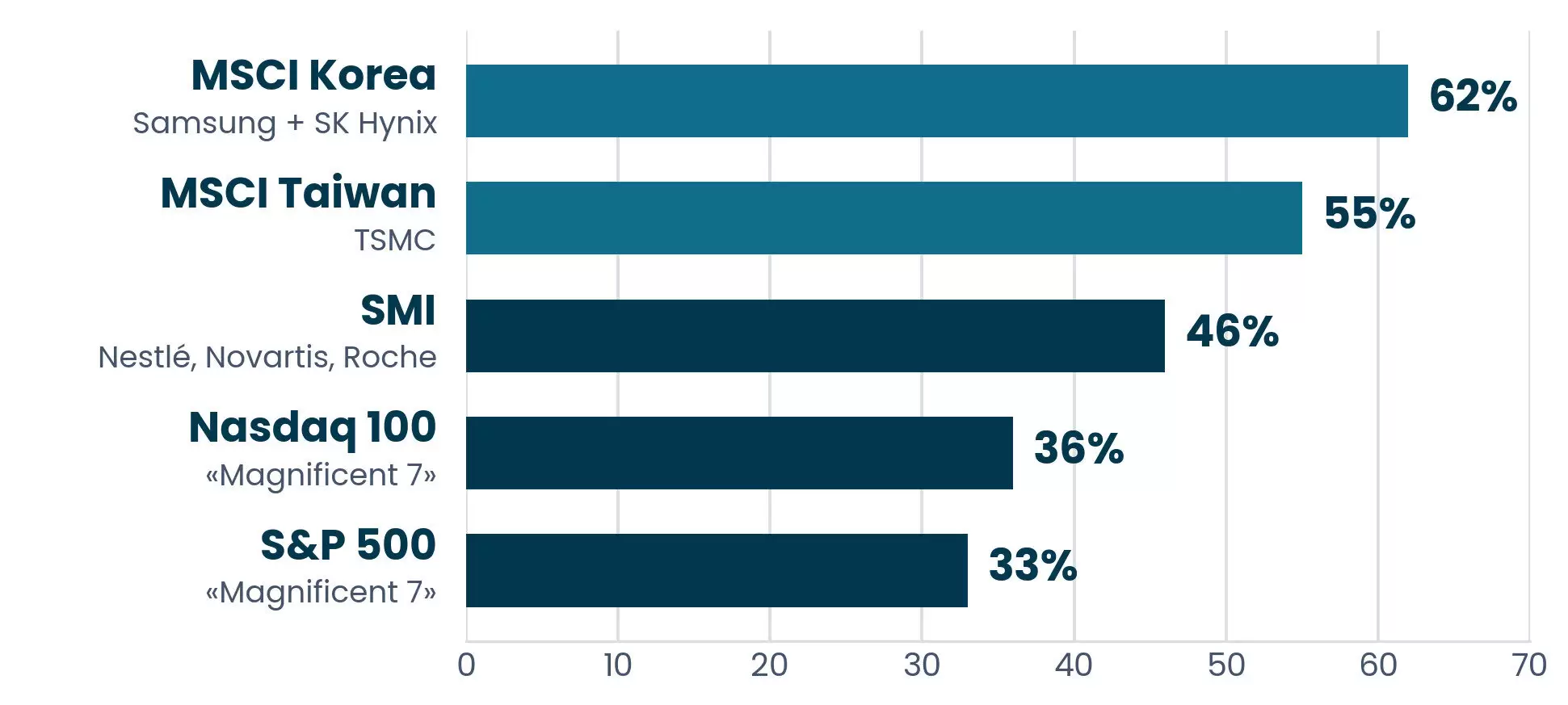
The result is a high concentration in a limited number of stocks (see figure). The “Magnificent Seven” – Nvidia, Apple, Microsoft, Alphabet, Amazon, Meta and Tesla – now account for around one third of the S&P 500, compared with only 12% in 2015. In the Swiss Market Index, Nestlé, Novartis and Roche together make up almost half of the index. In some markets, the concentration is even more pronounced: Samsung and SK Hynix account for almost two thirds of the MSCI Korea, while TSMC represents more than half of the MSCI Taiwan. Investors who believe they are broadly diversified may in practice be heavily exposed to only a few stocks or sectors.
A Narrow Slice of the Economy
Public equity markets also represent only a small part of a country’s real economy – and this share continues to decline. In the US, for example, 81% of companies with more than USD 100 million in revenue are privately owned and not listed on a stock exchange. Investors who rely exclusively on index ETFs therefore exclude a significant part of the value-creating corporate universe.
Geographical weights have also shifted significantly in recent years, partly as a result of relative market performance. The US now represents around 70% of the MSCI World – almost twice as much as two decades ago. Investors who follow market capitalisation mechanically accept these concentrations directly in their portfolios. Japan illustrates how quickly dominant market weights can change: in 1990, the country represented 44% of the global equity index; today, its share has fallen to just 6%.
SpaceX: A Test Case
The recent IPO of SpaceX illustrates how powerful the mechanics of passive investing can be. With a valuation of around USD 2 trillion, SpaceX was already a heavyweight at the time of listing. As a result, passive investment vehicles are effectively forced to buy the stock on an ongoing basis – regardless of its investment quality. Some index providers, such as the technology exchange NASDAQ, have even relaxed their inclusion criteria to allow the stock to be added to the index more quickly.
Such forced buying can push valuations even higher. The fact that pension assets, in particular, may flow into such positions largely automatically – without individual investment decisions being actively challenged – deserves critical attention.
Conclusion
Index funds and ETFs have made investing more efficient and more accessible. At the same time, however, rule-based capital flows are gaining market influence. Capital is increasingly channelled into the largest companies – often detached from their valuation levels – creating new structural risks. In recent years, concentration risks have risen significantly, both at the level of individual stocks and sectors and in relation to the broader real economy. At the same time, automated investment processes have further reinforced pro-cyclical market effects.
A deliberately active and risk-controlled investment approach can help reduce hidden concentration risks, for example through more balanced portfolio construction and disciplined rebalancing. In addition, alternative investments such as private markets can provide further sources of diversification by opening access to a much broader universe of value-creating companies.
Passive investing remains efficient and cost-effective. The key is to manage its risks actively.
Author: Rafael Gonzalez
We are at your service
Your personal partner for all matters relating to your assets.
We look forward to hearing from you!