
Energy in Transition
The recent military escalation in the Middle East has once again exposed the vulnerability of global supply chains. The Covid crisis and the Russian gas crisis of 2022 already demonstrated how exposed economies are to such disruptions.
Around 20 million barrels of crude oil pass through the Strait of Hormuz daily — one fifth of global supply. The region also accounts for roughly 25% of global LNG exports, 30% of worldwide nitrogen fertiliser exports (critical for agriculture), and 40% of helium (critical for medical technology, semiconductor manu-facturing, aerospace, etc.) must transit the Strait of Hormuz. Following the US-Israeli airstrikes against Iran in late February 2026, the Brent price temporarily surged above USD 115 per barrel, while European gas prices reacted even more sharply. The disruption at the Strait of Hormuz hits a world already in the midst of a fundamental shift.
The Greater Energy Shift
The energy market is undergoing a structural transformation. A key driver is artificial intelligence (AI). In 2025, global investment in data centres exceeded USD 580 bn for the first time, surpassing upstream oil investment (USD 540 bn). Meta, Amazon, Alphabet and Microsoft alone invested a combined USD 320 bn in AI infrastructure in 2025. The International Energy Agency (IEA), in its Electricity 2026 report, describes the dawn of the “Age of Electricity”: power is assuming an increasingly dominant role in the energy system. Transport, heating, industry and digital infrastructure are all being electrified, driving rapid growth in electricity demand. Notably, the IEA has for the first time upgraded transmission grids from a supporting function to a central bottleneck. Power generation is expanding fast, but grids are struggling to keep pace.
Data Centres on Overdrive
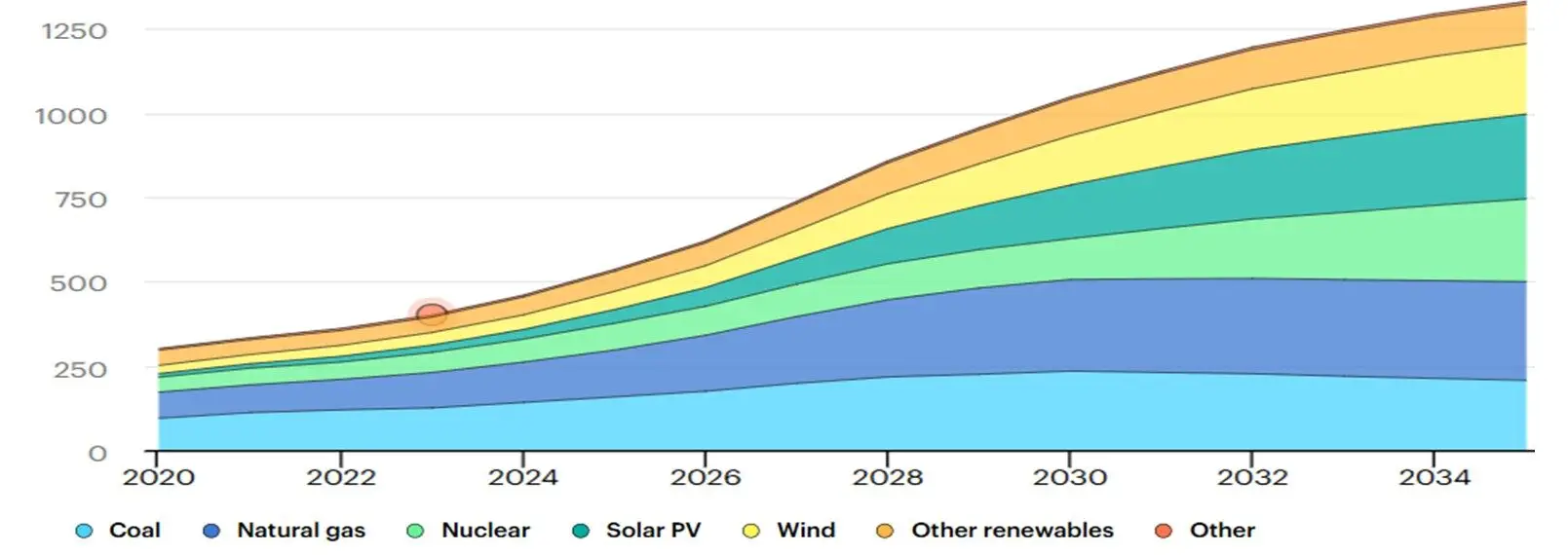
Global data centre electricity consumption is expected to double by 2030 to over 945 terawatt-hours (TWh) according to the IEA (see figure) — equivalent to Japan’s entire annual consumption today. Renewables will be able to cover just under half of the incremental demand, but in the near term, gas- and coal-fired generation will also benefit. Towards the end of the decade, Small Modular Reactors (SMRs) are moving into focus. These are compact, modular nuclear reactors that tech companies are increasingly investing in for captive use. The power needs of the future are immense, and they are reshaping the entire energy landscape.
The Foundation of Electrification
Expanding energy infrastructure requires vast quantities of raw materials. The IEA projects supply deficits of 30% for copper and 40% for lithium by 2035 — both essential materials for grids, batteries and electrification. Base metals are thus becoming a bottleneck for the energy transition. Moreover, supply chains are highly concentrated: a single country, namely China, controls the refining of 19 of 20 strategic energy minerals, with an average market share of 70%. In parallel, nuclear energy is experiencing a renaissance. The World Nuclear Association (WNA) expects global nuclear capacity to double by 2040, yet uranium demand already exceeds current mine production. The IEA expects annual investment in nuclear energy to triple from around USD 70 bn today to approximately USD 210 bn by 2035.
Conclusion
The geopolitical shock in the Middle East underscores the vulnerability of global supply chains. The higher oil price, how-ever, masks a fundamental shift in the energy market towards power genera-tion. For investors, this creates opportu-nities along the entire value chain — from copper and lithium to energy stor-age and uranium, but also in the com-panies that enable electrification in the first place: grid infrastructure, building automation and intelligent power distri-bution. Those who invest in the infra-structure of the energy transition and the raw materials it requires stand to benefit from a structural tailwind that extends well beyond the current crisis cycle.
Author: Rafael Gonzalez
We are at your service
Your personal partner for all matters relating to your assets.
We look forward to hearing from you!